STATE OF AI REPORT 2020.
The most widely read and trusted analysis of key developments in AI.

Explore the full report

Bigger models, rising costs, and a first clinical milestone
The third report captured the rise of GPT-3 and the cost of scaling language models. AI-first biology reached a clinical milestone, companies invested in the work of deploying models, and universities faced a widening resource gap with industry. The pandemic did not stop progress, but it made the distinction between promising research and useful deployment especially important.
Published on October 1, 2020, this edition captures what we knew then. The findings and predictions below retain that historical perspective.
Read the original Nathan Benaich’s launch essay, or explore the 2020 report by topic.
Let’s dive into the key stories.
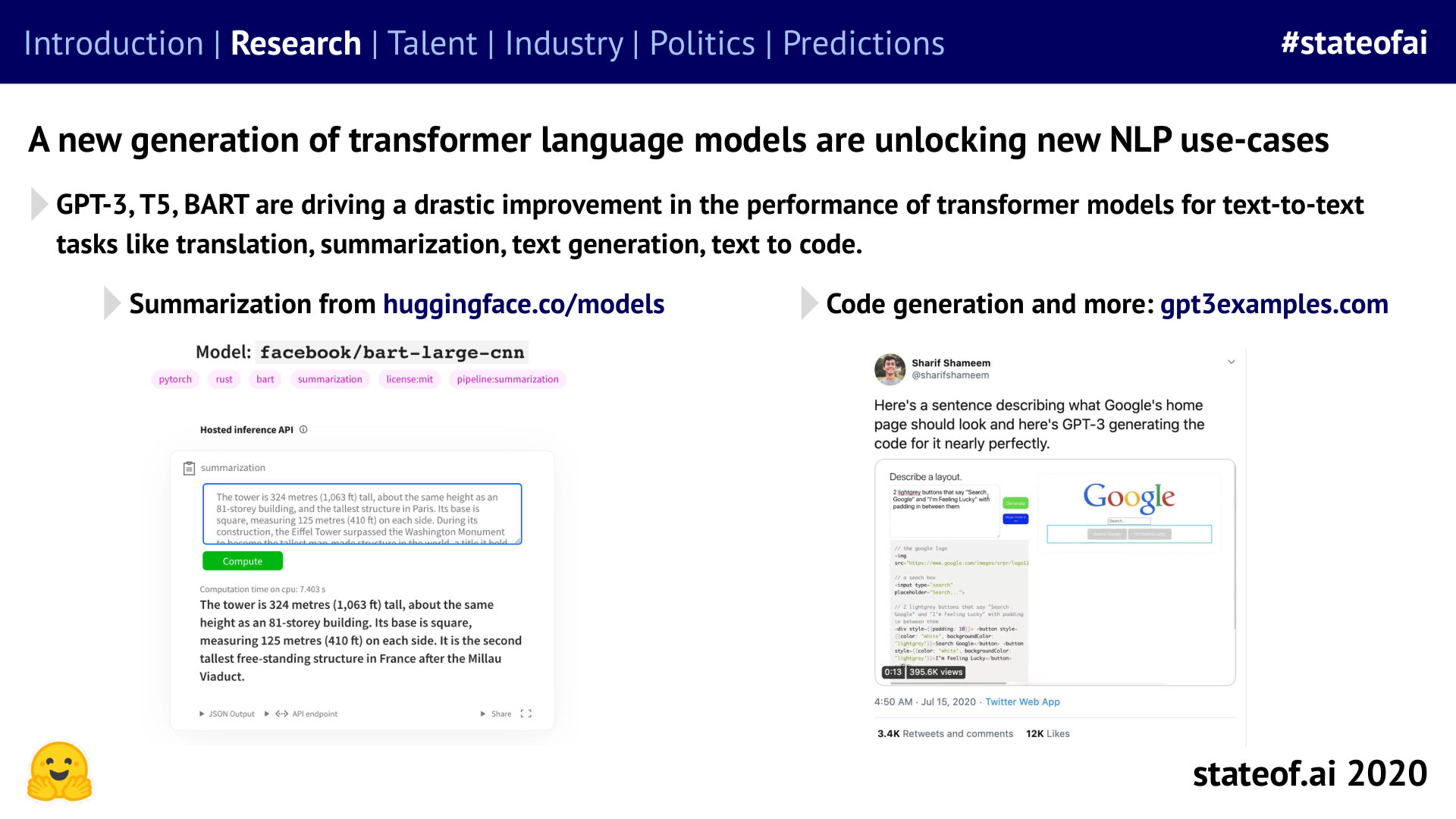
Language models grow more capable and less open
The 2020 report described language models that could generate, summarize, translate, and turn text into code. Scaling offered a route to better results across tasks, but the ability to inspect and reproduce research lagged behind the headline capabilities.
A paper could describe an important advance without providing the code needed to recreate it. The report’s code-availability analysis made that gap visible. Readers should distinguish learning that a result exists from having the implementation, data, and resources needed to test or extend it.
Scaling creates a growing resource divide
Better language-model results increasingly depended on larger models, more data, and more compute. The 2020 report asked who could afford that trajectory. It also showed that rising frontier budgets could coexist with falling compute needs for a fixed level of performance.
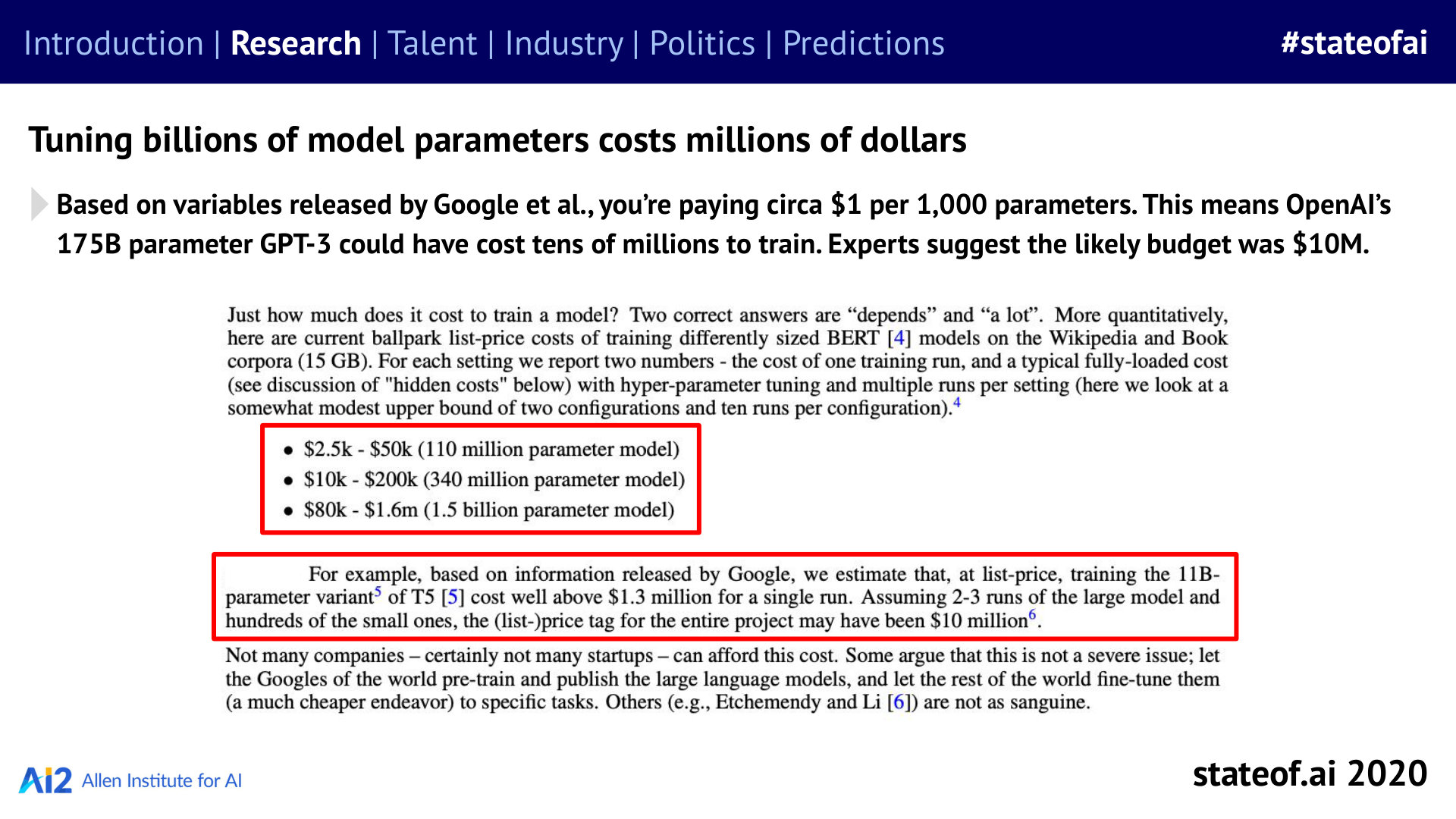
The report’s efficiency result asked how much compute was needed to reach a fixed ImageNet performance level. Frontier-model spending asked a different question: how far could performance be pushed? Falling cost for an existing target could therefore coexist with rising expenditure on more ambitious models.
Research talent moves toward well-funded institutions
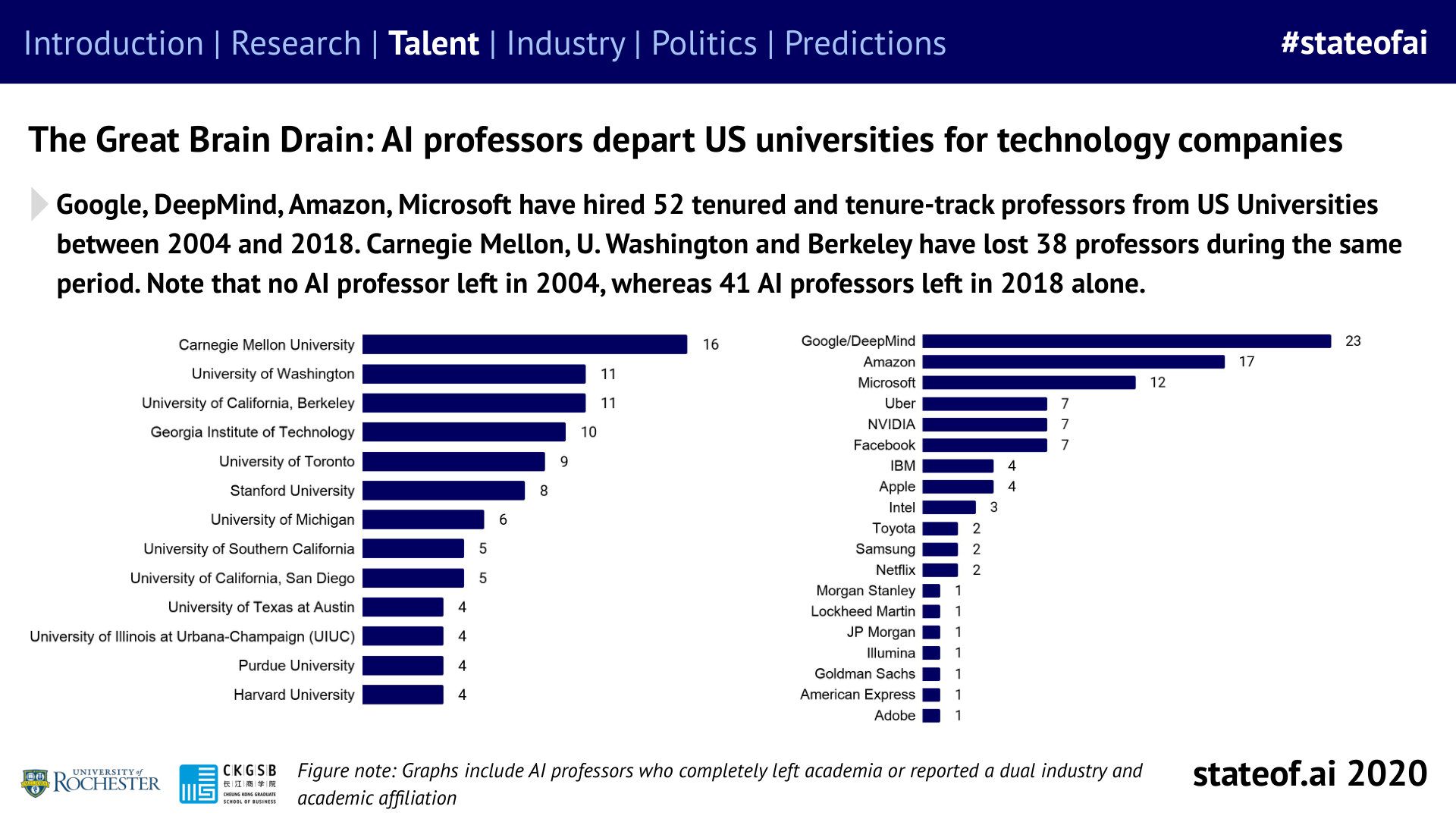
The 2020 report examined the relationship between universities and large technology companies. Academic expertise moved into industry, while international education and migration underpinned US research strength. Simple national labels could obscure how researchers moved between institutions and countries.
A $100 million donation supported the creation of the Roux Institute at Northeastern University. The report described graduate programs spanning computing and analytics alongside AI-first biology, including genomics, bioinformatics, and precision medicine. Eleven corporate partners had joined. The initiative showed one way institutions were trying to connect technical training with specific scientific and industrial problems.
The work shifts from building models to running them
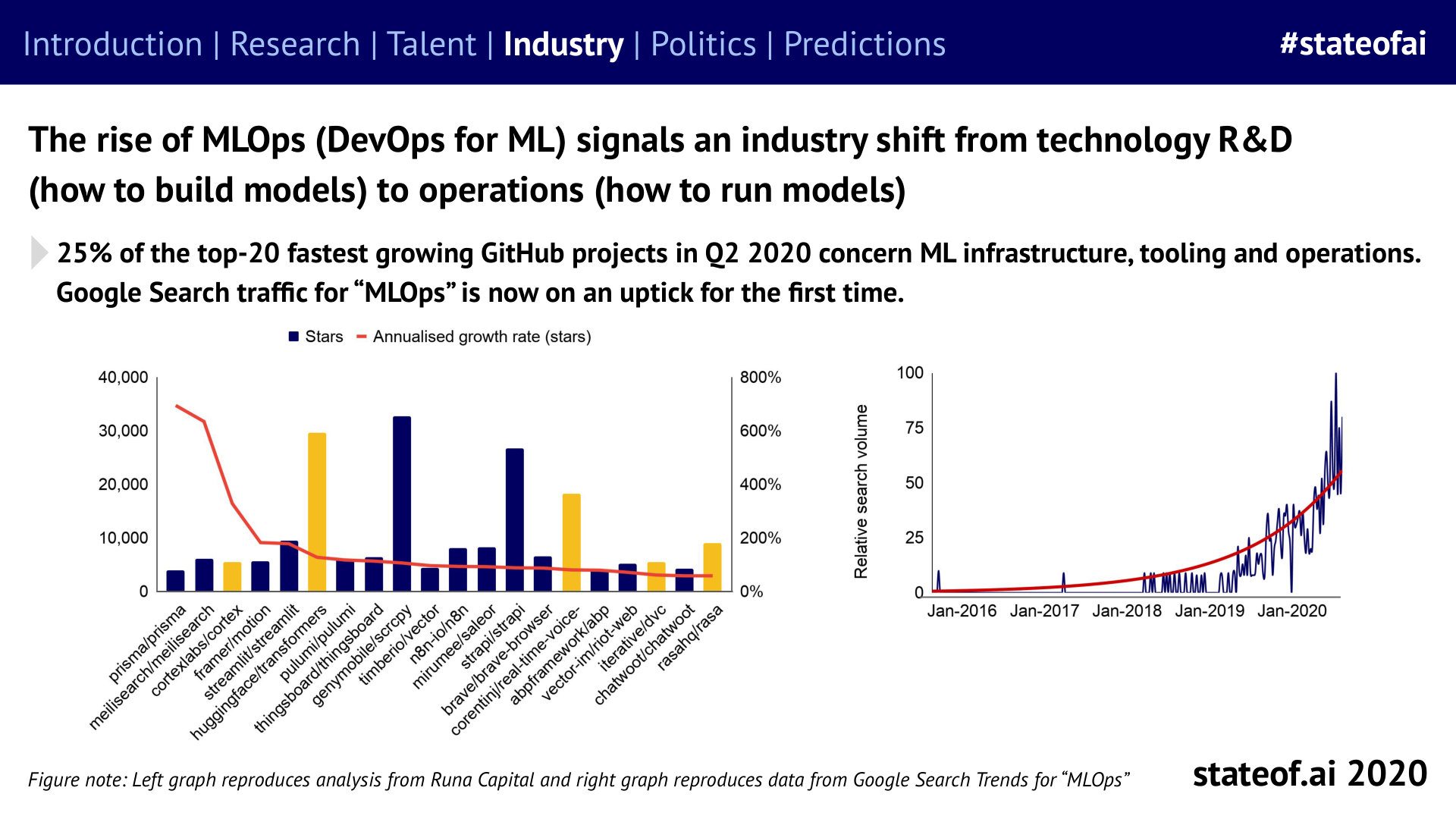
The 2020 report tracked an industry learning how to operate AI products. Infrastructure and deployment tools became more prominent, and larger funding rounds continued during the pandemic. Useful models still needed reliable workflows and viable economics around them.
UiPath had more than 7,000 enterprise customers and passed $400 million in annual recurring revenue by mid-2020, according to the report. Robotic process automation provided a commercial example alongside the funding and MLOps discussion. The figures described demand for operational automation at one company, rather than revenue attributable to AI across the software industry.
AI-designed molecules reach clinical testing
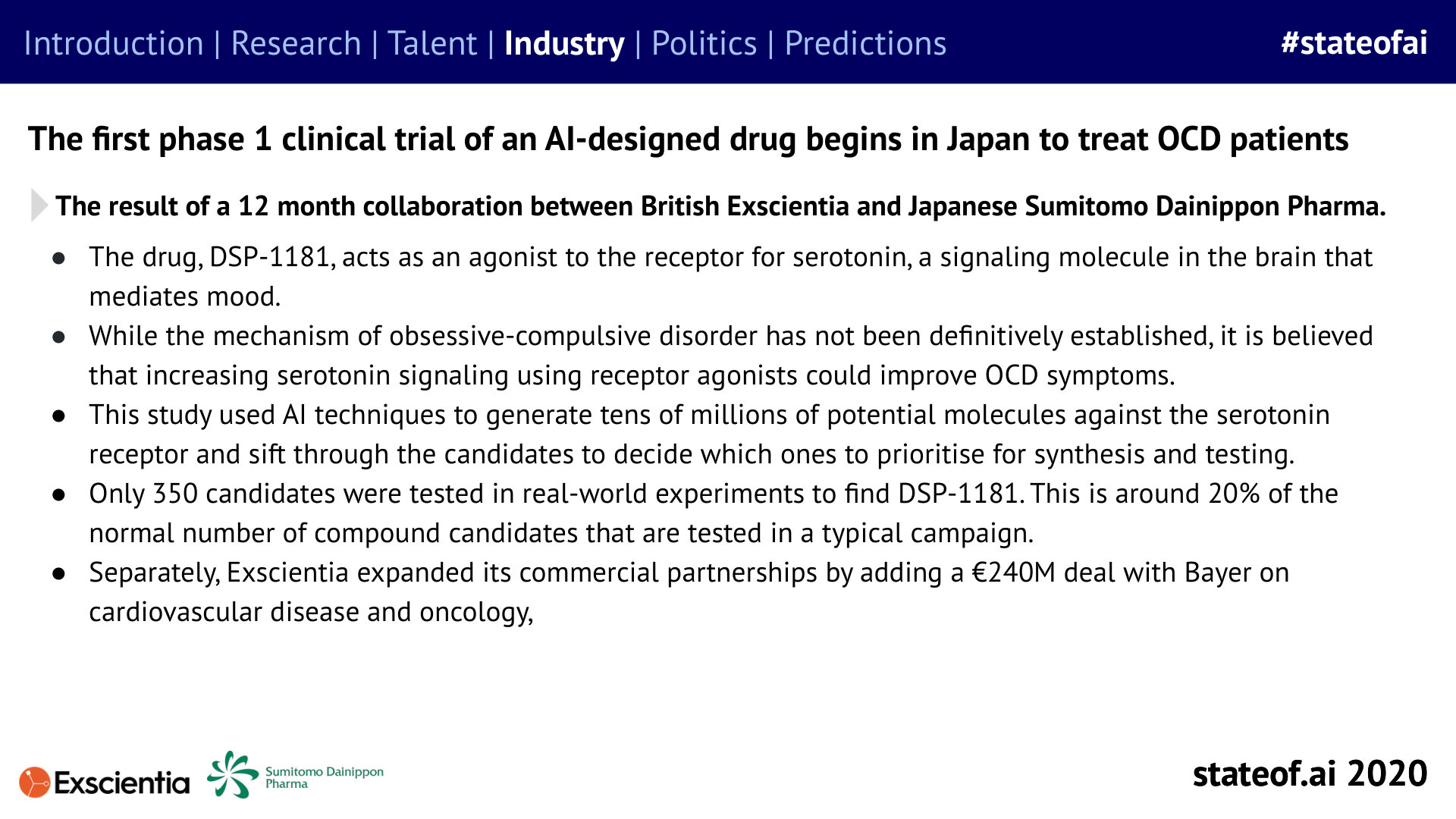
The 2020 report highlighted two different stages of AI-assisted drug discovery: finding promising activity in preclinical experiments and advancing an AI-designed candidate into a human trial. Both mattered, but neither was equivalent to an approved treatment.
The report’s annualized estimate put biology publications using AI methods above 21,000 in 2020. It reported growth above 50% a year since 2017, covering methods such as deep learning, NLP, computer vision, and reinforcement learning. This measured the spread of a research toolkit across biology. It complemented individual discovery examples without establishing that every paper produced a validated biological result.
AI policy becomes a question of deployment and supply chains
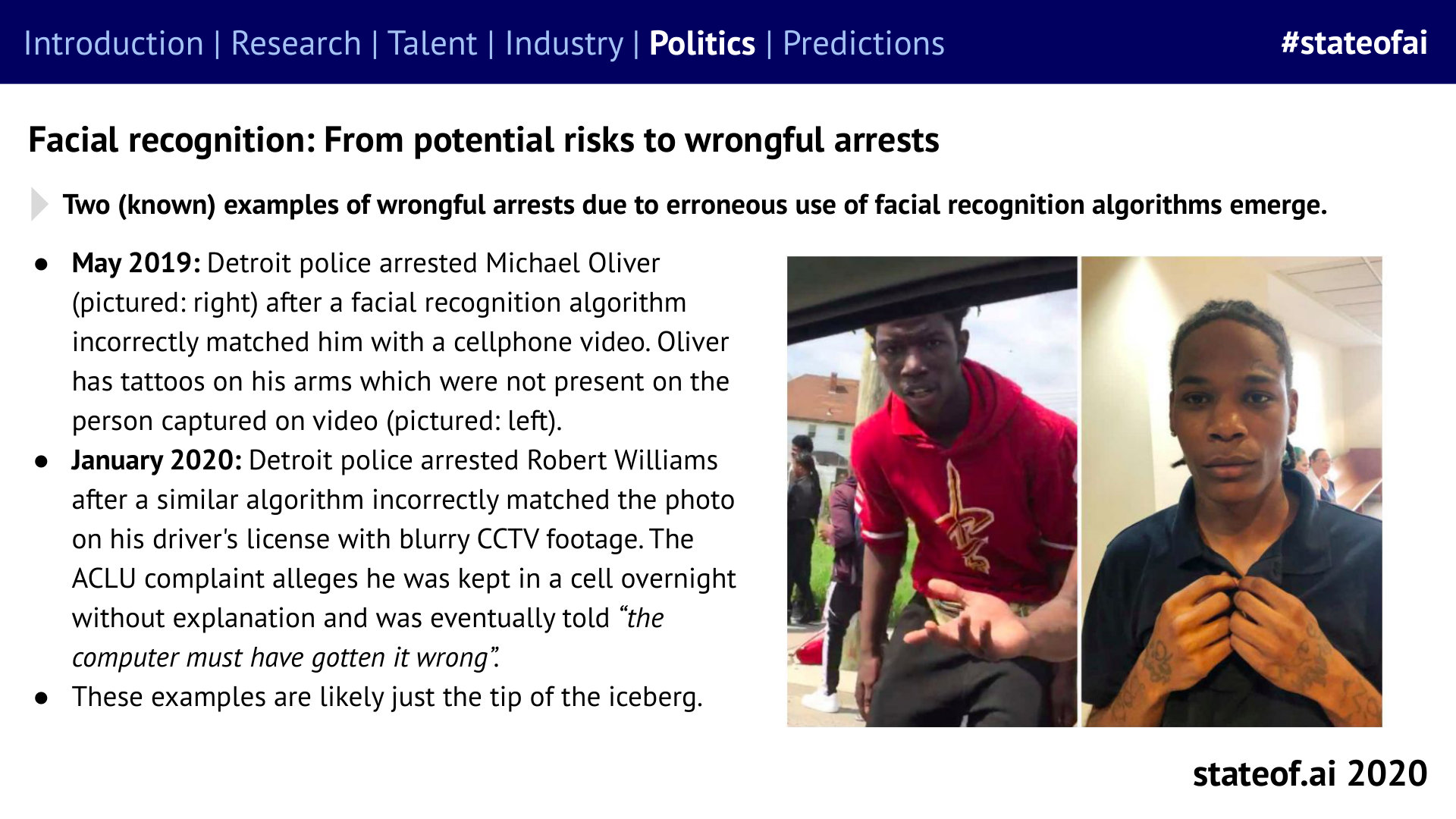
The 2020 report connected AI policy to concrete systems: police facial recognition and the semiconductor supply chain. Both exposed dependencies beyond the model itself, including institutional decisions, manufacturing capacity, and cross-border relationships.
The report described US reliance on advanced semiconductor manufacturing alongside TSMC’s substantial sales to US customers. That made the relationship more complex than a one-way dependency. Announced investment in Arizona was relevant to diversification, but an announcement did not mean production capacity was already available.
The 2020 forecasts, in their original form
The pandemic-year forecasts covered model scale, vision transformers, drug discovery, defense startups, and the proposed NVIDIA-Arm deal. These are historical forecasts made at publication, not new predictions or retrospective claims of success.
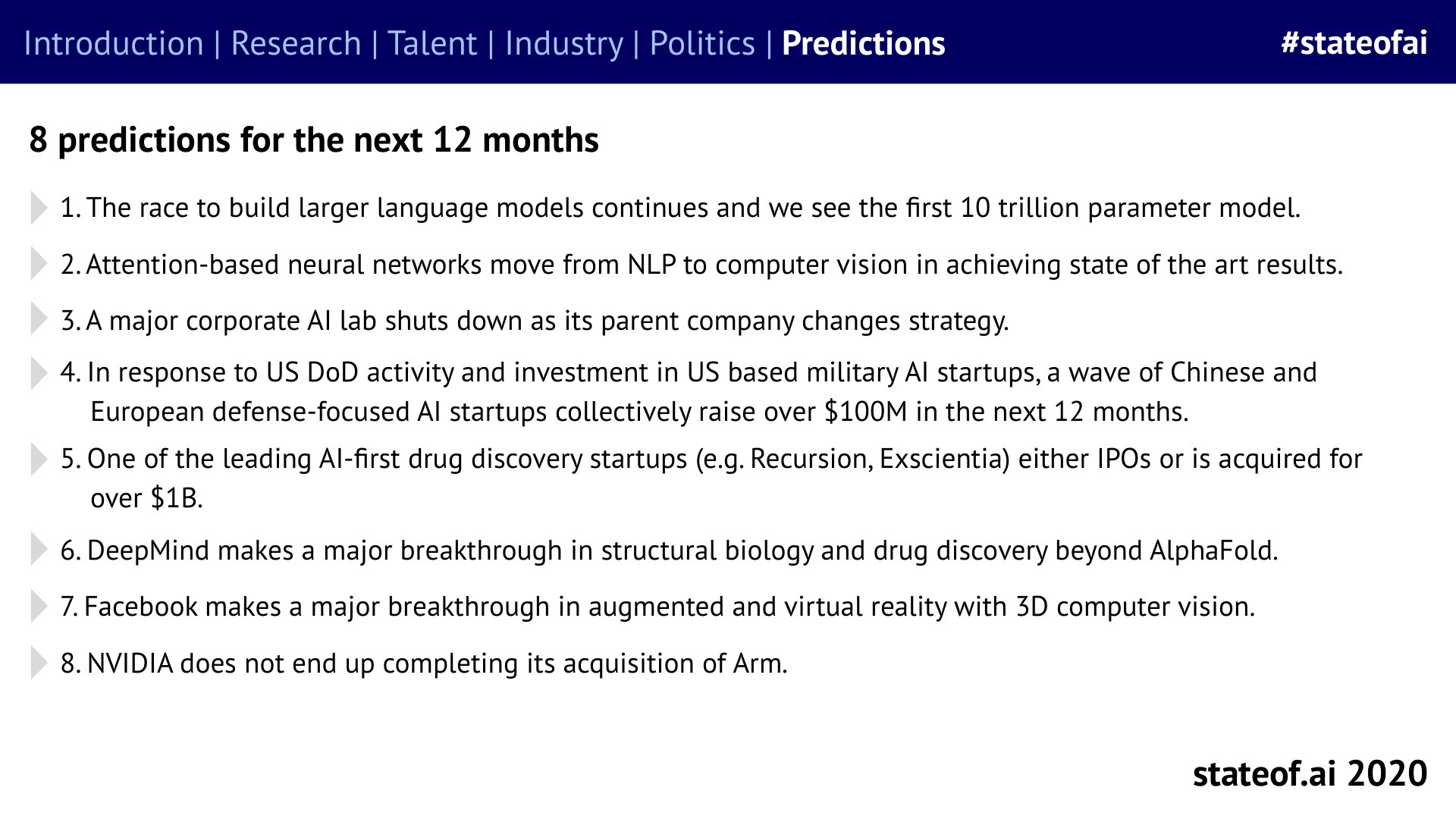
The 2020 list named technologies, organizations, financing thresholds, and a proposed acquisition. Those details made the predictions easier to assess later. They should remain visible even when subsequent events make a forecast look unusually prescient or clearly mistaken.
Three of the forecasts published in 2020:
- The race to build larger language models continues and we see the first 10 trillion parameter model.
- Attention-based neural networks move from NLP to computer vision in achieving state of the art results.
- A major corporate AI lab shuts down as its parent company changes strategy.
The report is authored by Nathan Benaich and Ian Hogarth
For our writing throughout the year, subscribe to Air Street Press.
Cite the report
Benaich, N. and Hogarth, I. (2020). State of AI Report 2020. https://www.stateof.ai/2020