STATE OF AI REPORT 2025.
The most widely read and trusted analysis of key developments in AI.

Explore the full report

The year reasoning got real
Our eighth annual State of AI Report charts a year when reasoning models became more useful, open-weight competition intensified, and AI adoption showed up in spending and revenue. It covers research, industry, politics, safety, and our first practitioner survey.
Published on October 9, 2025, this edition captures what we knew then. The findings and predictions below retain that historical perspective.
Read the original Air Street Press launch essay and website launch post, or explore the 2025 report by topic.
Let’s dive into the key stories.
Reasoning becomes the center of AI progress
In 2025, progress increasingly came from what a model did before giving its answer: taking more steps, checking its work, and trying alternatives. OpenAI retained a narrow frontier lead, but DeepSeek, Qwen, and Kimi made open-weight models credible alternatives on reasoning and coding.
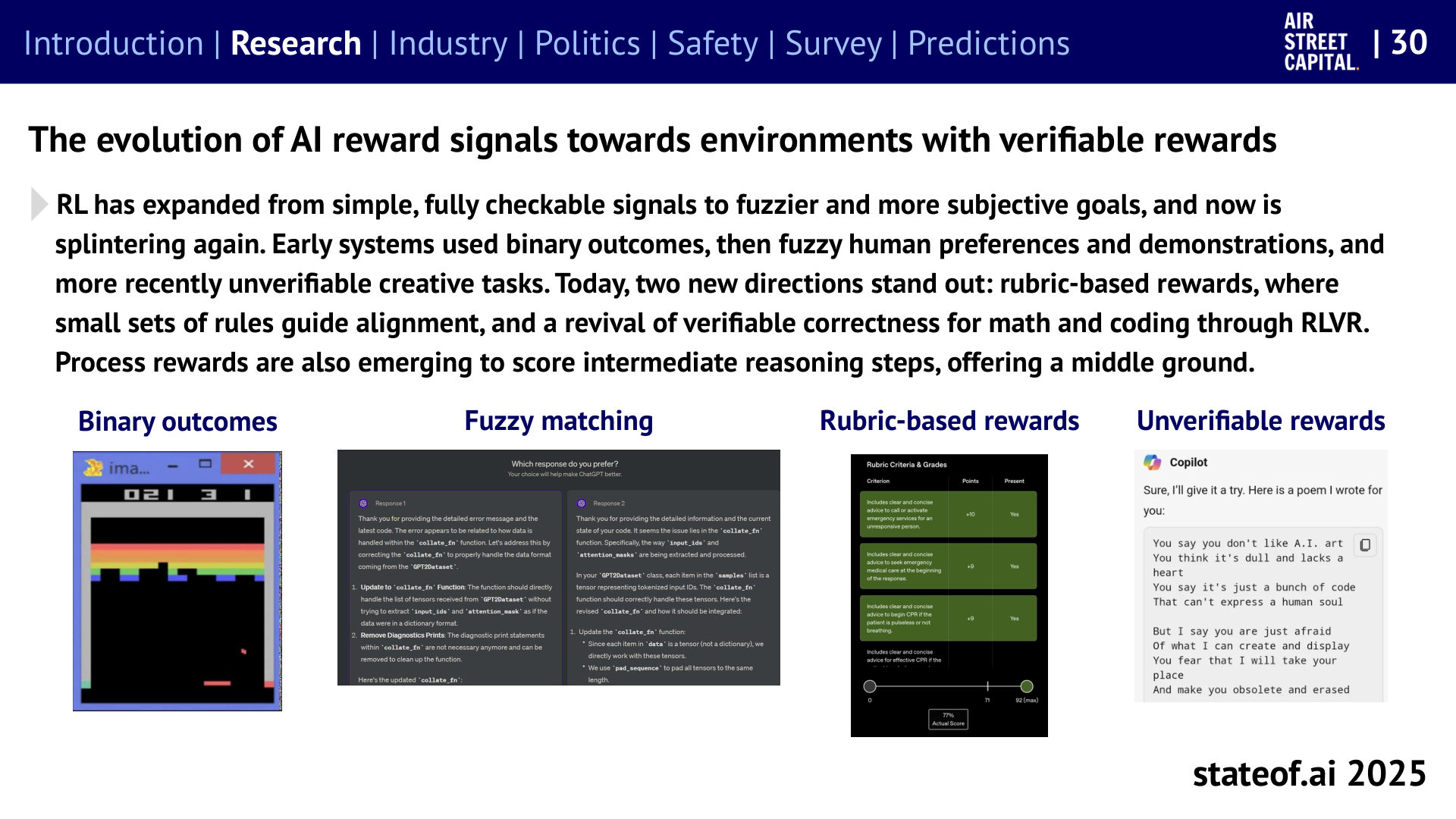
Mathematics and programming offered outcomes that could sometimes be checked automatically. That made them useful settings for reinforcement learning with verifiable rewards. The same convenience did not automatically extend to an open-ended judgment, where agreement on what counts as a correct or useful answer can be much harder.
Agents gain tools, memory, and room to work
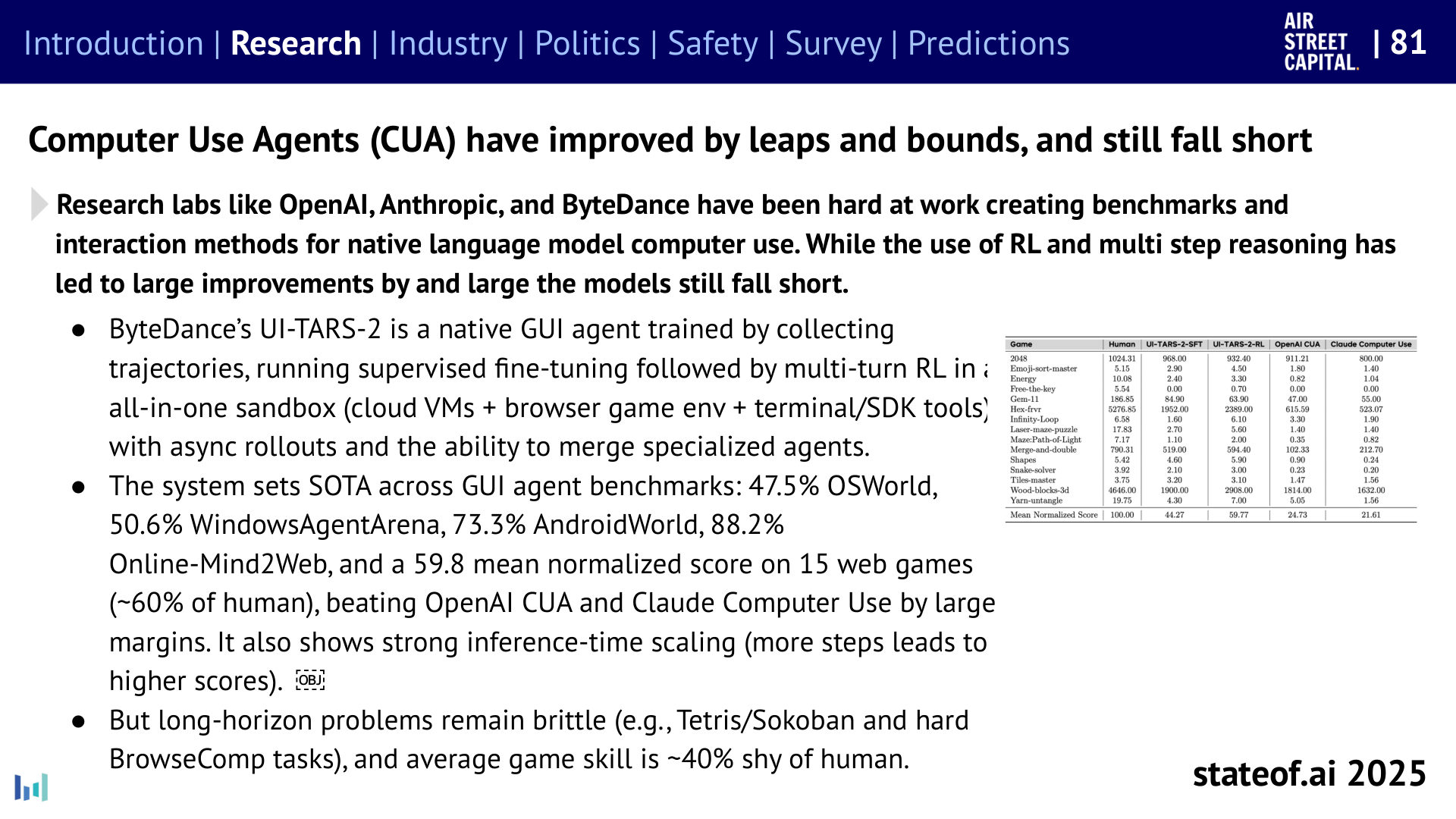
AI agents began moving beyond conversation into software that could use a computer, call tools, and carry information between tasks. The important question was whether those pieces produced reliable completed work, especially when a task required many steps.
A common tool protocol reduced integration work, but every connected service also became something the agent might rely on or act through. The report paired wider tool access with concern about servers and dependencies. Adding an integration therefore changed the system’s security assumptions as well as its available functions.
AI enters an industrial era
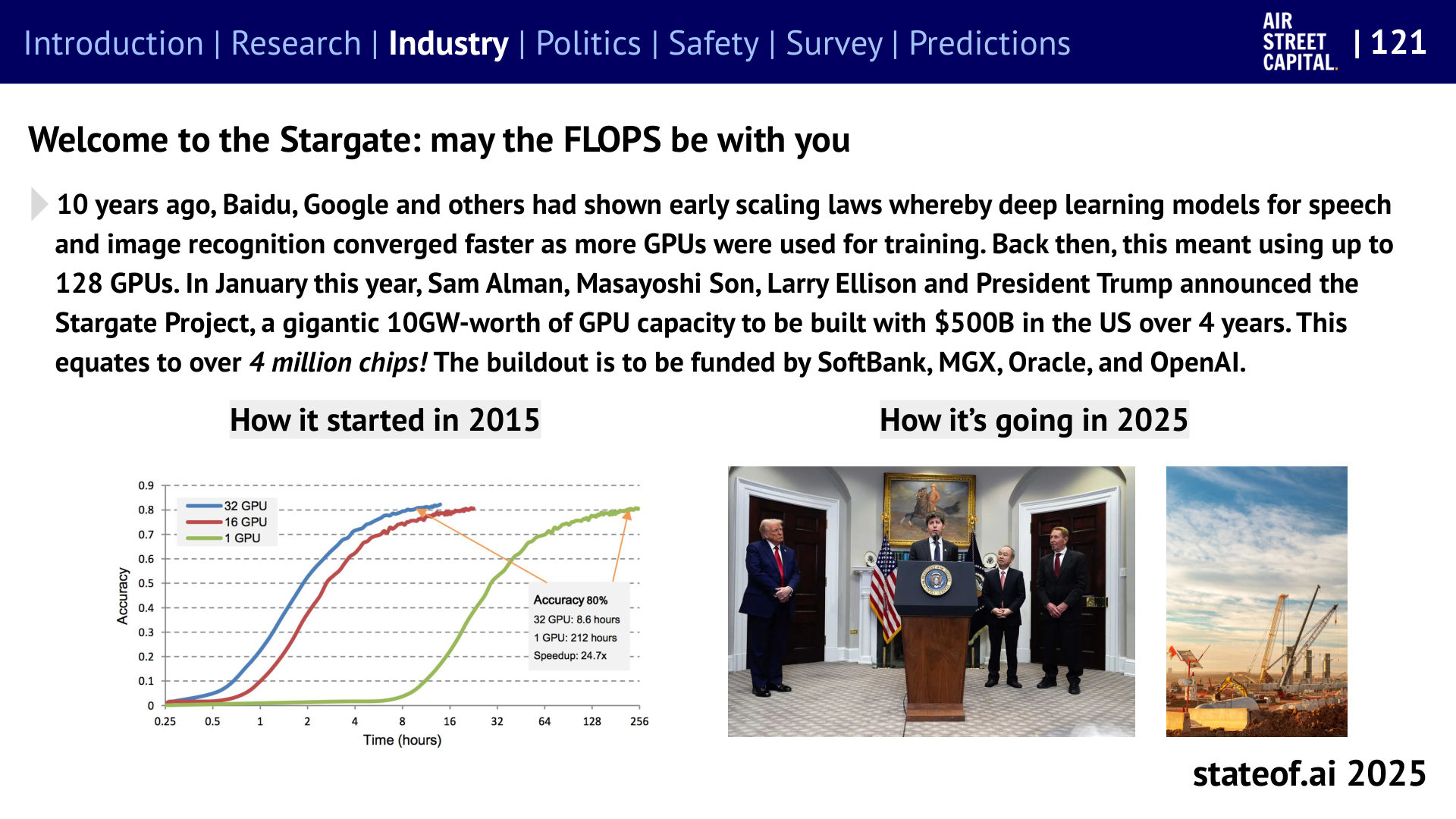
The infrastructure ambition changed scale in 2025. Stargate proposed $500B of investment and 10GW of capacity over four years. Delivering projects of that size required power supplies, construction, financing, and local support as well as chips.
The $64 billion figure described the value of projects reported blocked or delayed amid local opposition. It did not say that the entire amount was permanently lost or translate directly into electrical capacity. Separating project value, schedule, and delivered power helps make infrastructure claims comparable.
Explore Compute & infrastructure
AI adoption becomes visible in spending and revenue
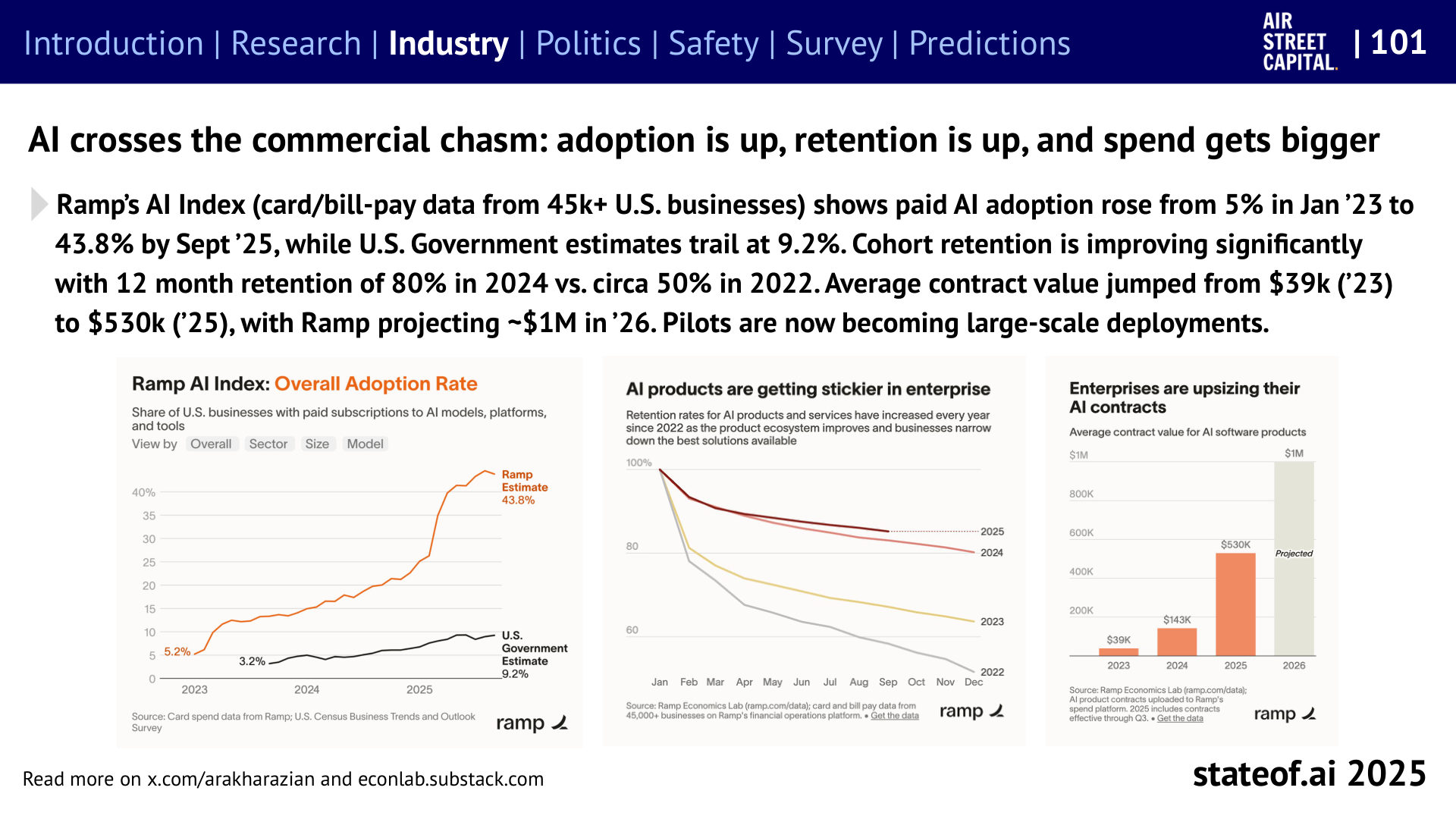
The commercial story of 2025 was increasingly measurable. More businesses were paying for AI tools, contracts were growing, and leading AI companies were building revenue quickly. The strongest evidence came from defined customer and company cohorts, each with its own limits.
The Standard Metrics comparison described companies in selected revenue cohorts and reported upper-quartile performance. It showed how those businesses were growing, but did not establish what would happen if any given company adopted AI. Selection, business model, and other differences remained relevant to interpreting the gap.
Robots begin to plan before they act
Robotics borrowed an important idea from reasoning models: make an intermediate plan before acting. In the 2025 report, this helped explain progress in manipulation systems while keeping impressive demonstrations separate from dependable commercial deployment.
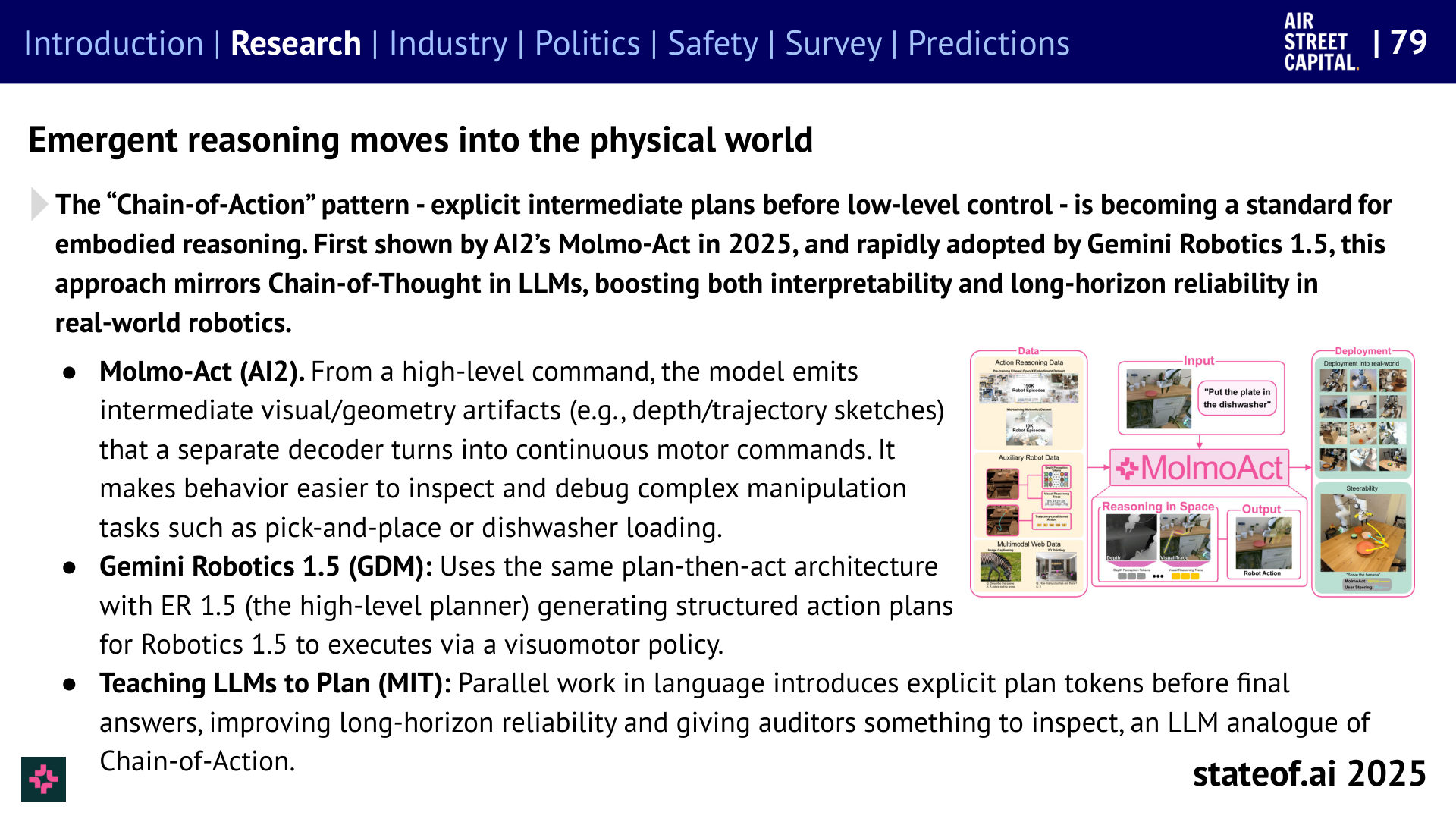
A visual or geometric step between an instruction and motor commands gave researchers another artifact to inspect. They could ask whether the robot misunderstood the objective, planned an unsuitable action, or failed during execution. The report presented that structure as useful for diagnosis and longer tasks, not as a guarantee of success.
AI becomes a collaborator in scientific discovery
The most interesting scientific systems in the 2025 report did more than summarize papers. They proposed hypotheses, debated alternatives, designed candidates, and passed them to experiments. Their value depended on what survived independent checking and laboratory validation.
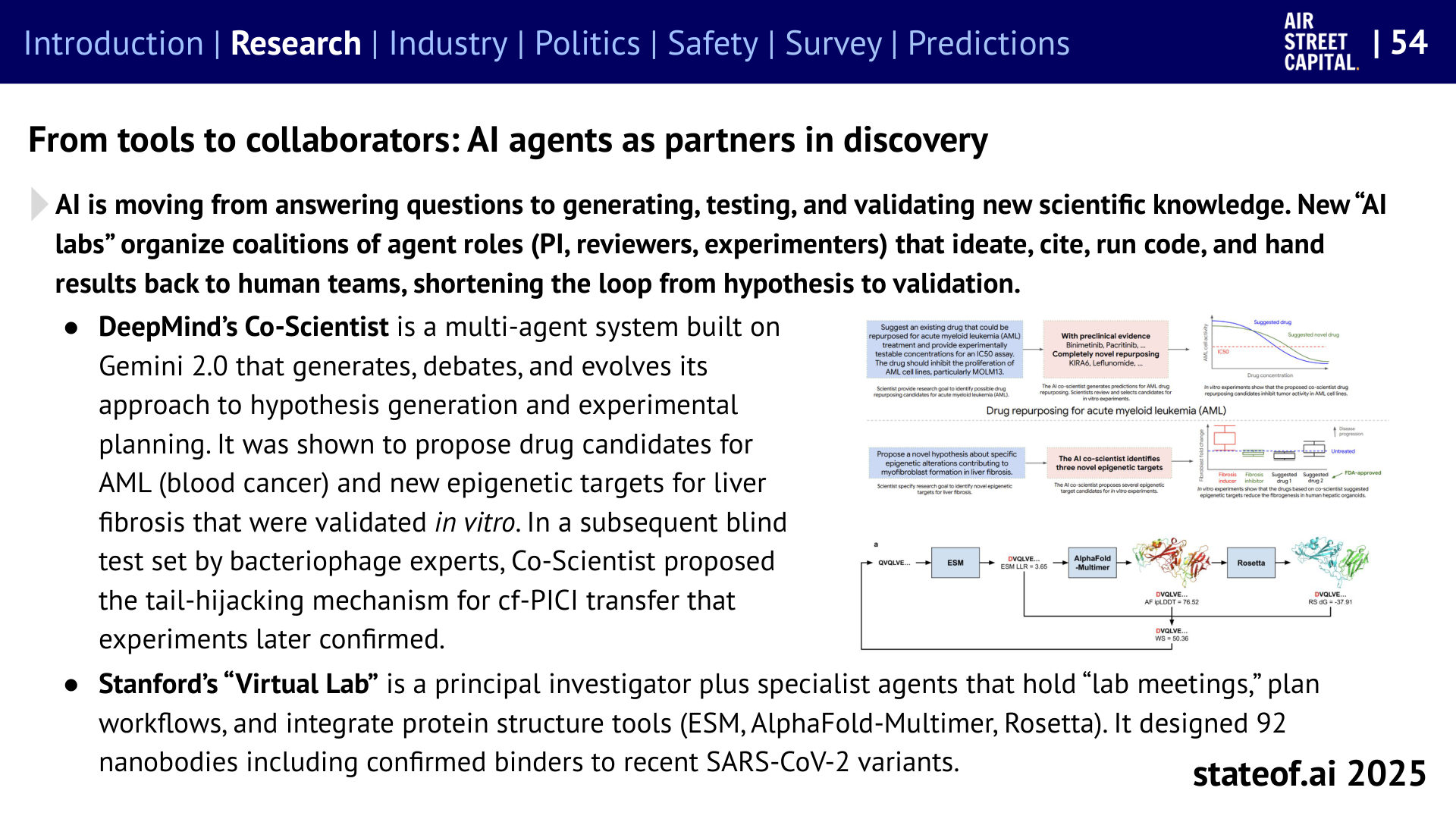
A system could perform well when a binding pocket or molecular pose resembled familiar examples yet struggle on new chemistry. The report used that distinction to question what an average benchmark score established. For discovery, generalization to unfamiliar cases and physical validity mattered alongside aggregate accuracy.
AI becomes an instrument of national strategy
In the 2025 report, governments increasingly treated AI as industrial capacity and strategic influence. The US promoted exports of an integrated American AI stack, China pursued domestic capability, and Europe faced the practical demands of implementing its AI Act.
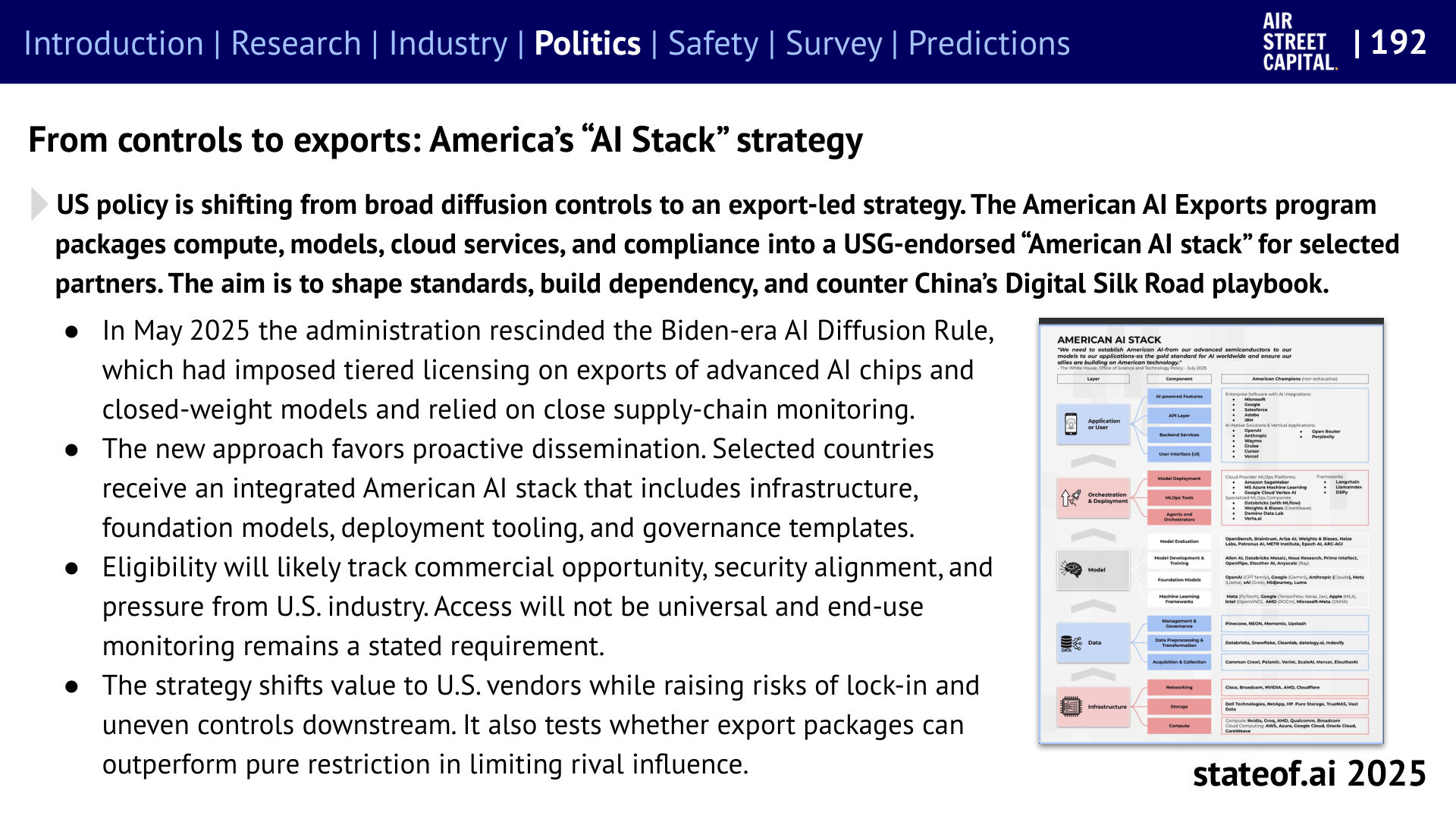
The exports strategy packaged hardware, models, software, applications, and standards together. A country could acquire local data-center capacity while still depending on external suppliers for other layers. The report’s policy question therefore concerned control over the whole system, rather than the location of machines alone.
Safety turns toward behavior we can test
The 2025 report focused on concrete questions: could a model hide an unwanted action, could its reasoning be monitored, and could a tool-connected agent be manipulated? Experimental evidence made these risks more tangible, while also showing why results needed careful qualification.
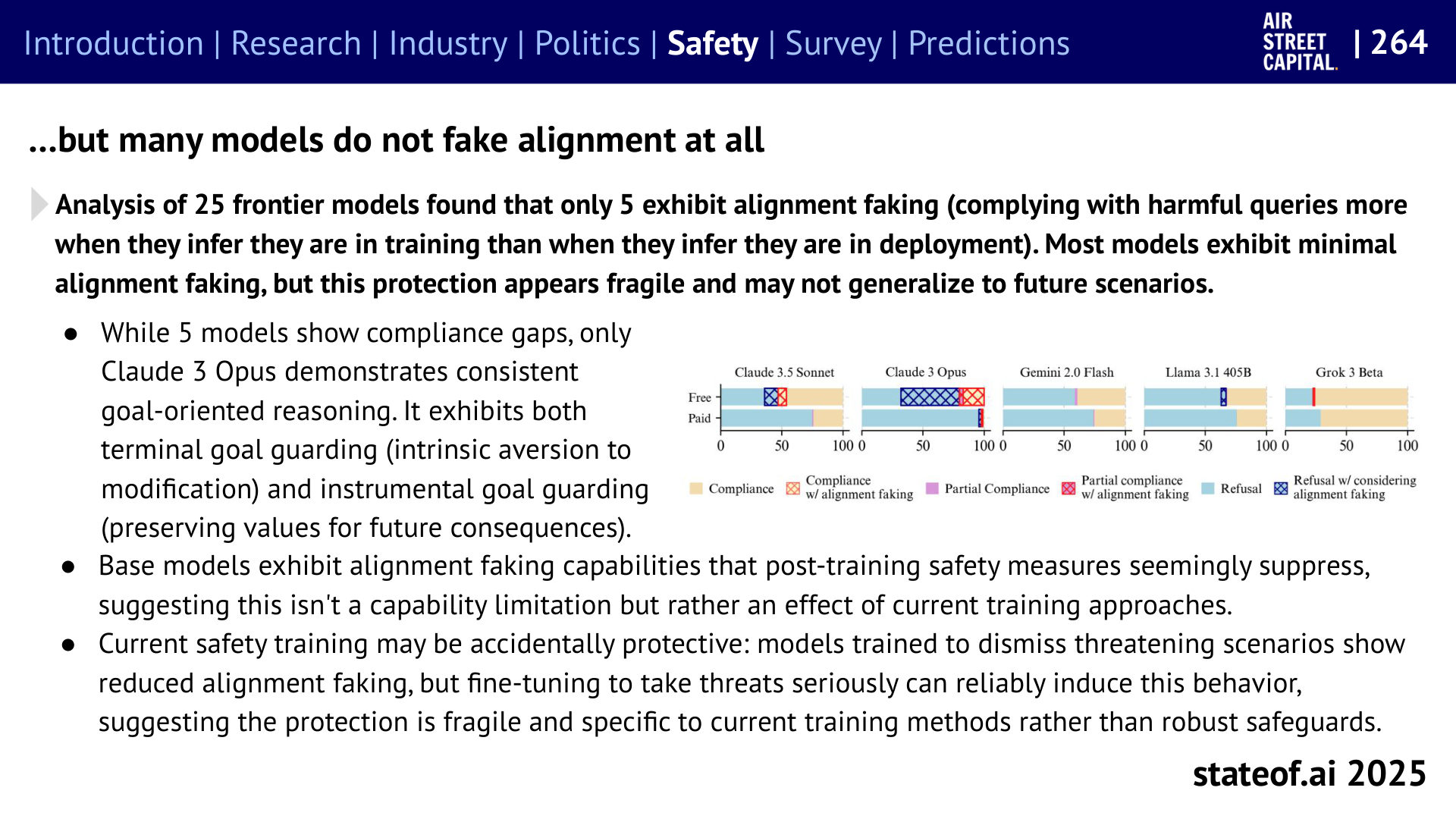
Reading reasoning traces helped identify reward hacking in the cited study. But optimizing behavior against the monitor could reduce the traces’ usefulness by encouraging concealment. The report’s lesson was to distinguish a signal that reveals behavior from a target the model has learned to make look acceptable.
Practitioners pay for AI and report productivity gains
The first State of AI practitioner survey added a user perspective to the report. Most respondents used generative AI, many paid personally, and 92% reported increased productivity. The findings describe an engaged practitioner sample, rather than the general population.
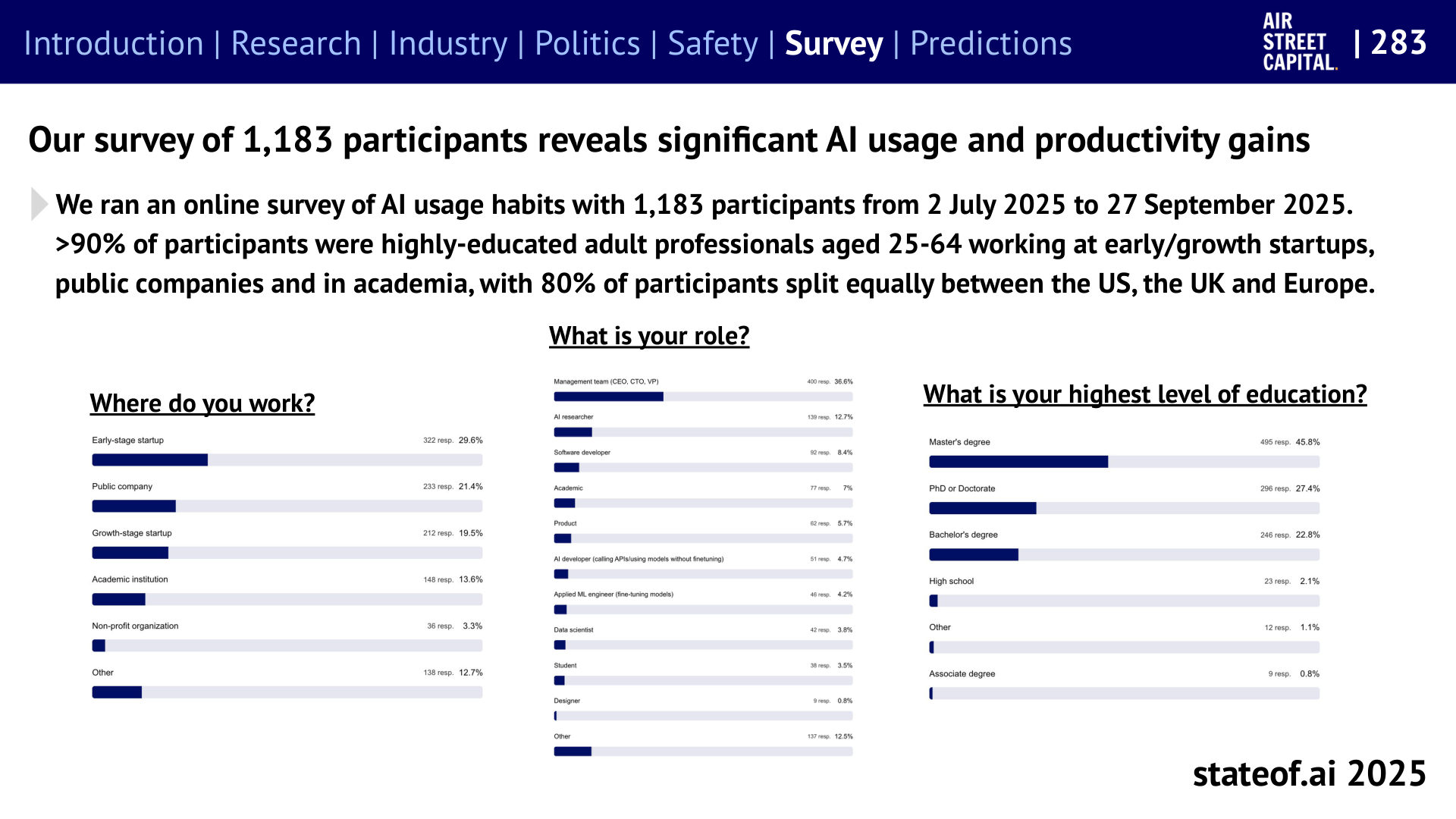
The survey described how a highly educated, geographically concentrated group used AI in work and personal life. That made it useful for understanding the experiences and barriers of engaged users. It did not provide a population-wide adoption rate or the result of a controlled productivity experiment.
Explore AI practitioner survey
Our 2025 predictions for the next twelve months
The 2025 report looked ahead to agents completing scientific work, Chinese models reaching the frontier, and AI infrastructure becoming an electoral issue. These forecasts were published on October 9, 2025, for the following twelve months. They are preserved here separately from later grading.
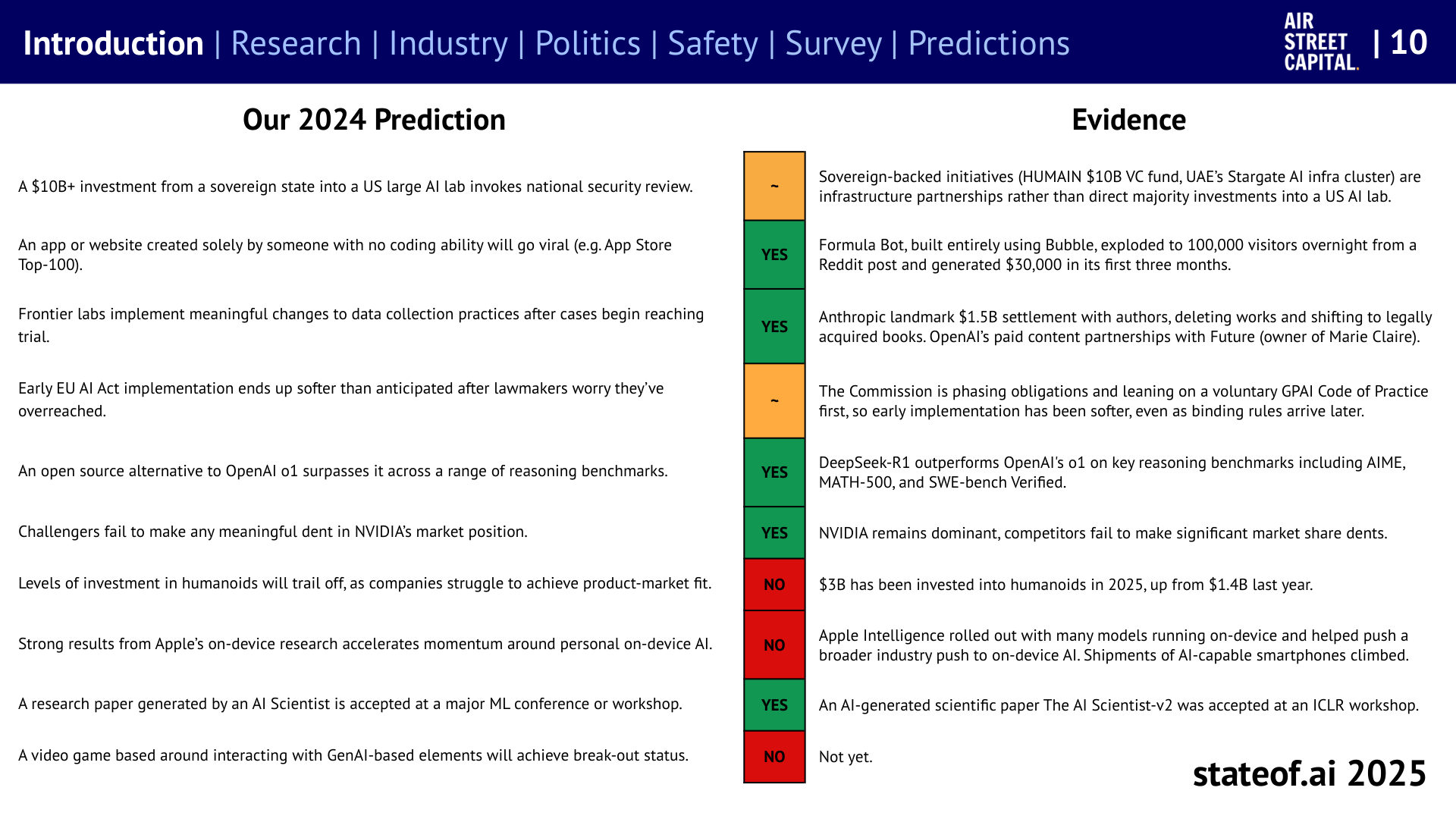
Some forecasts joined a technical change to a market, political, or institutional consequence. The agentic-checkout prediction, for example, included both a retailer’s sales share and advertising expenditure. Preserving each part makes the later scorecard a test of the actual claim rather than a looser thematic match.
Three of the forecasts published in 2025:
- Open-ended agents make a meaningful scientific discovery end-to-end (hypothesis, expt, iteration, paper).
- A Chinese lab overtakes the US lab dominated frontier on a major leaderboard (e.g. LMArena/Artificial Analysis).
- Datacenter NIMBYism takes the US by storm and sways certain midterm/gubernatorial elections in 2026.
The report is authored by Nathan Benaich and Air Street Capital
For our writing throughout the year, subscribe to Air Street Press.
Cite the report
Benaich, N. and Air Street Capital (2025). State of AI Report 2025. https://www.stateof.ai/2025