STATE OF AI REPORT 2022.
The most widely read and trusted analysis of key developments in AI.

Explore the full report

Generative AI opens up before the ChatGPT era
Published in October 2022, the fifth report captured diffusion models, new independent labs, and a rethink of how language models should be scaled. AI reached deeper into science and software, while chip access became more strategic. For the first time, the report gave AI safety its own section. This edition predates the public launch of ChatGPT.
Published on October 11, 2022, this edition captures what we knew then. The findings and predictions below retain that historical perspective.
Read the original Air Street Press launch essay and website launch post, or explore the 2022 report by topic.
Let’s dive into the key stories.
Diffusion spreads and scaling laws change
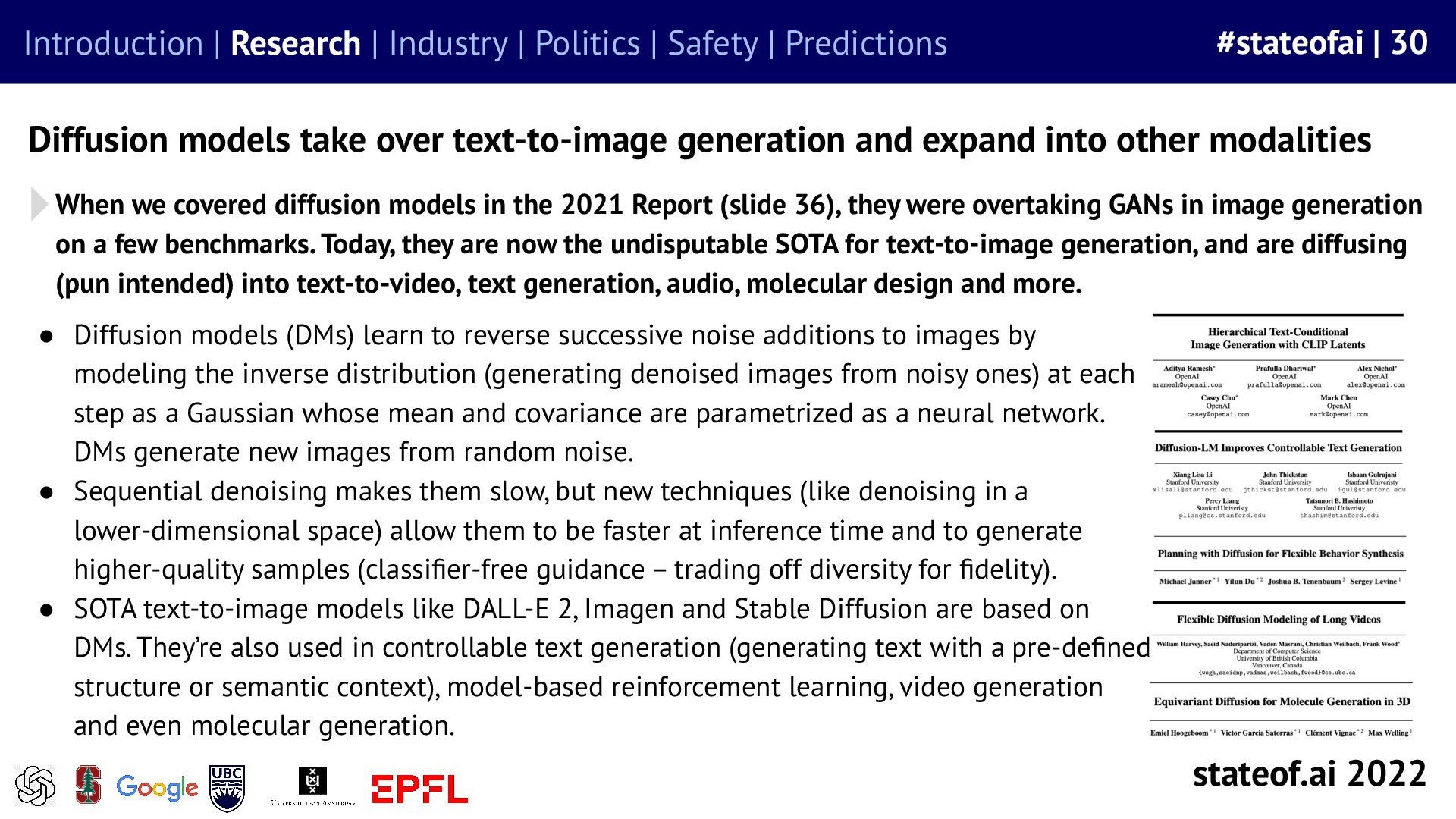
The 2022 report followed a rapid expansion in generative models. Diffusion systems made high-quality image generation broadly visible, while Chinchilla showed that model size alone was the wrong guide to training investment. New independent labs challenged the idea that leading results had to come from a few established organizations.
Google’s Minerva used a language model trained further on scientific and mathematical text, combined with intermediate reasoning steps and majority voting. It scored 50.3% on MATH in the report. OpenAI’s work instead used a theorem prover in the Lean formal environment. These were distinct approaches: Minerva’s benchmark could check a final answer without establishing that every reasoning step was valid, while formal proving imposed explicit rules on the proof.
Models learn to use tools and act in environments
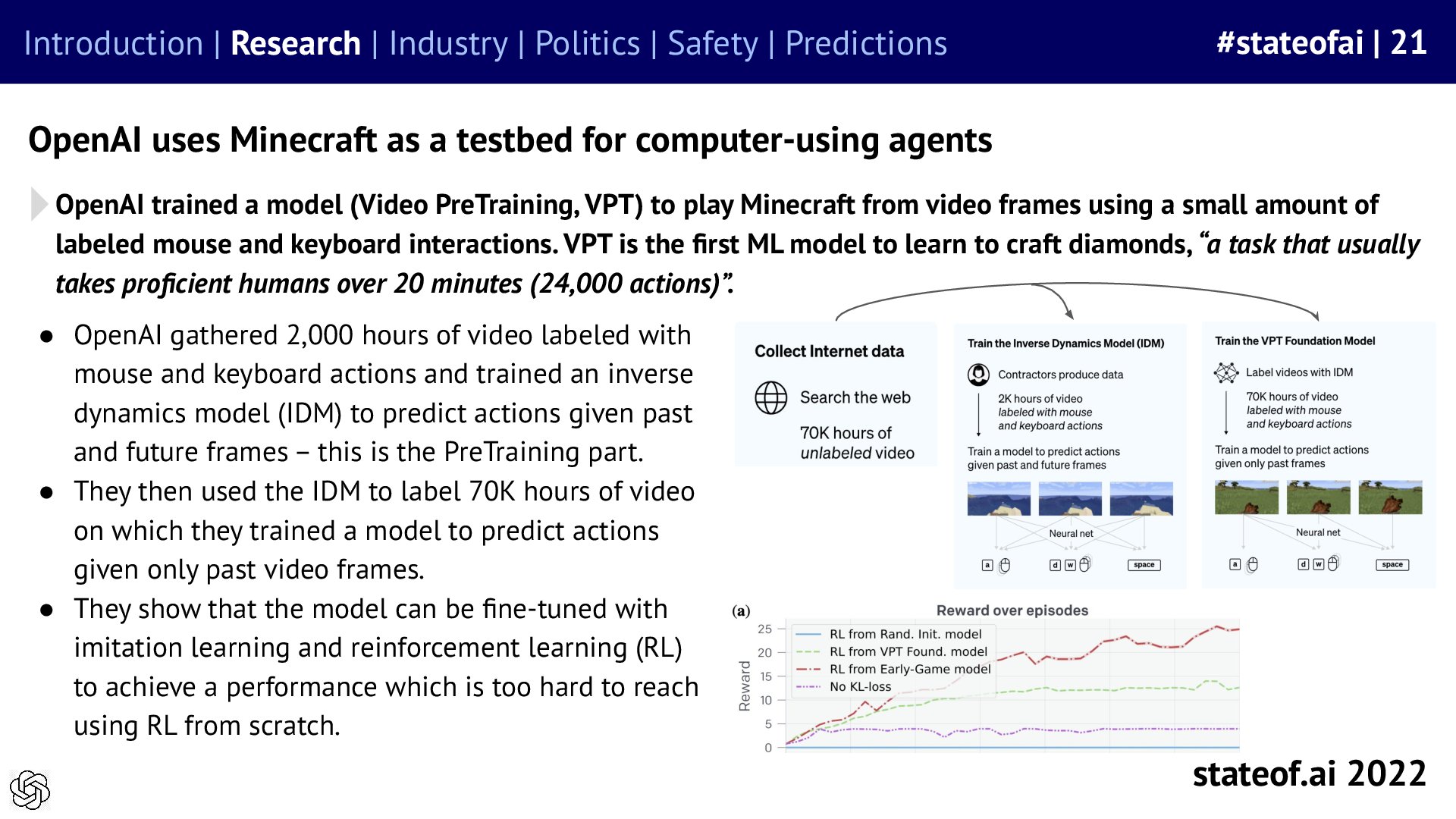
The 2022 report described early routes from generating text to performing actions. Models learned from videos, used search interfaces, and proposed robot actions. Each route needed a connection between the model’s outputs and what an environment or tool could actually do.
SayCan separated a language model’s suggestion from an estimate of which robot skills were feasible. Its different planning and execution success rates made that distinction measurable. An agent needed both a sensible sequence of actions and the practical ability to carry them out in its environment.
Explore AI agents and robotics
Open research still depends on concentrated hardware
The 2022 report contrasted a wider range of AI labs with a highly concentrated hardware ecosystem. Researchers could share models and code, but access to accelerators and large training budgets still shaped who could run leading experiments.
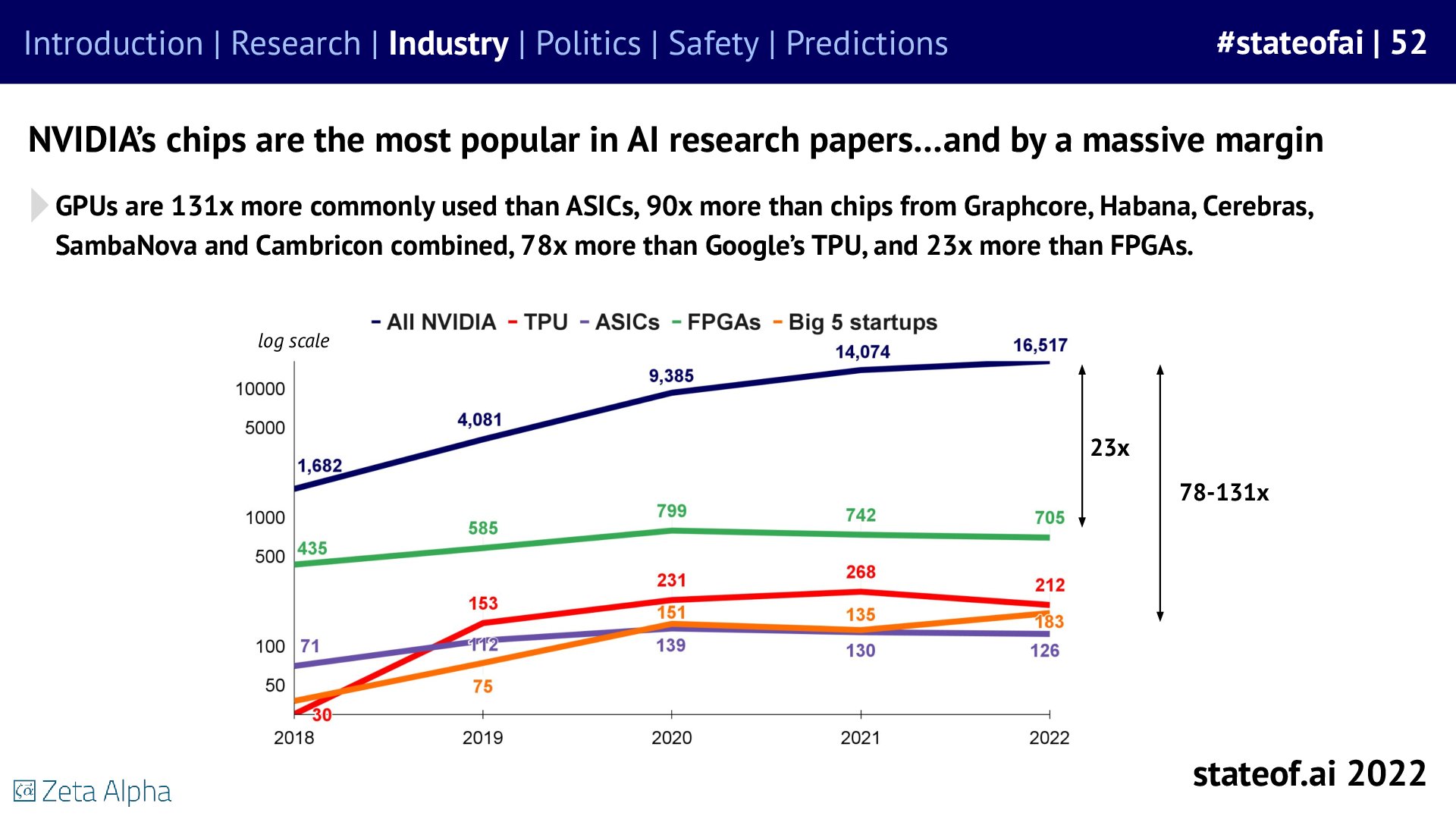
The hardware analysis looked at mentions or use in research papers, providing evidence about what researchers relied on. It was useful for understanding the ecosystem around an accelerator. It was not a direct measure of chips shipped, installed capacity, revenue, or utilization inside private data centers.
Products reach users as funding slows
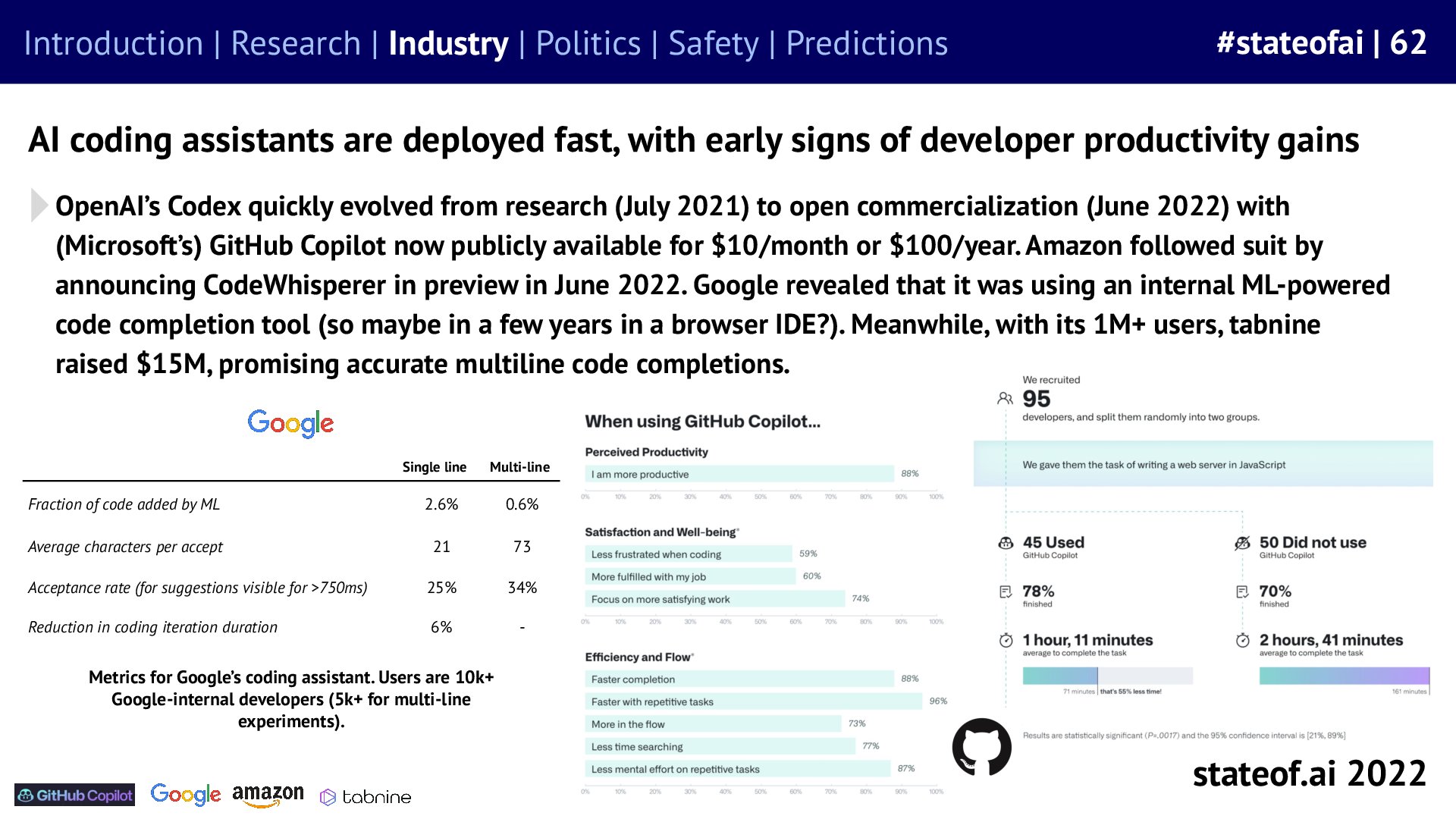
The 2022 report showed research turning into products while the financing environment weakened. Coding assistance reached a paid offering, AI-first drug-discovery pipelines advanced, and investment estimates fell from the previous year’s peak. These were different measures of commercial progress.
The 18-asset count showed AI-first drug-discovery companies moving candidates into clinical testing. It did not mean 18 successful treatments. The distinction matters when comparing scientific progress with business traction: pipeline growth can precede both clinical readouts and evidence of commercial benefit.
AI tackles protein structures and plasma control
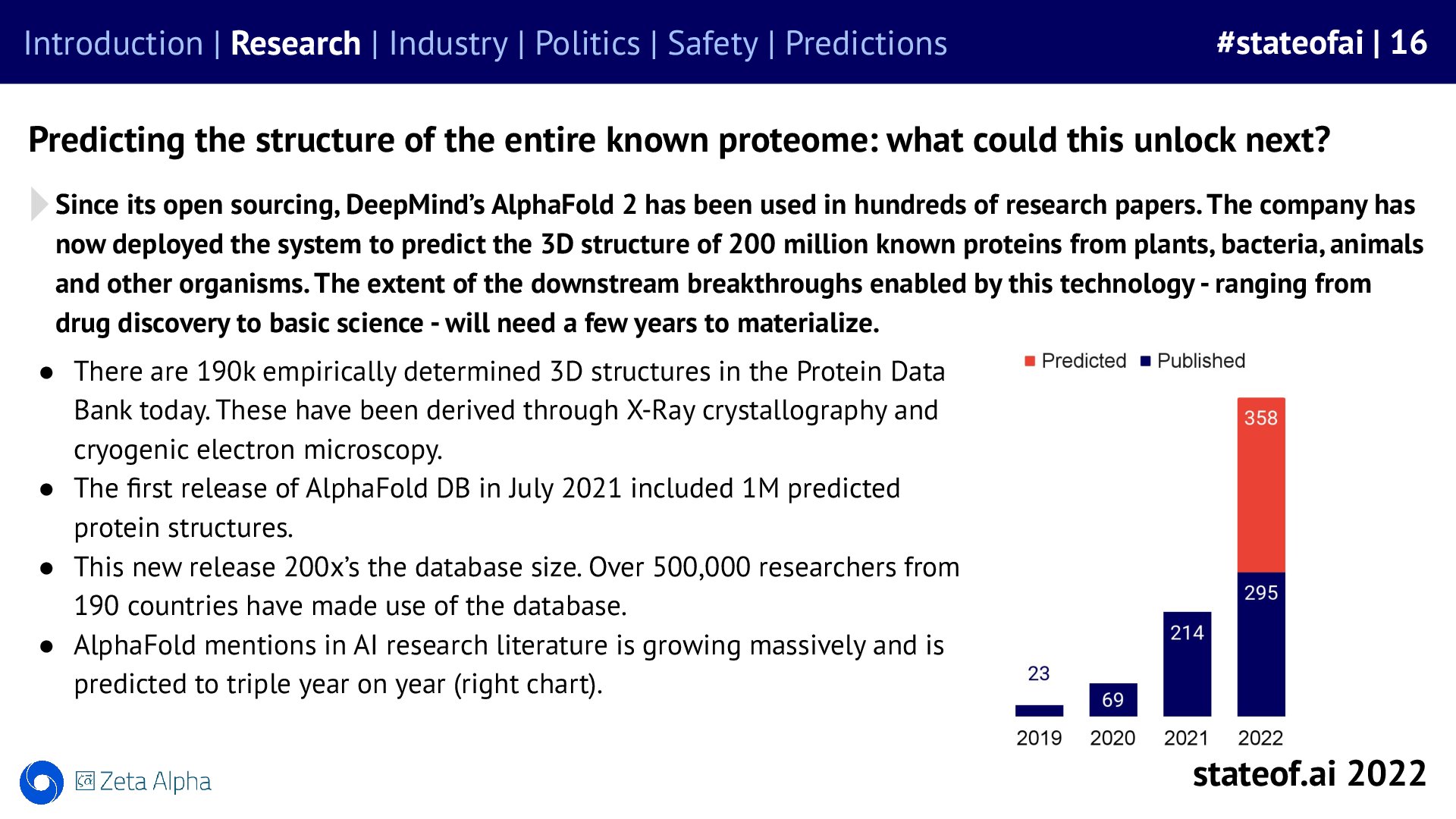
The 2022 report showed AI becoming useful across scientific domains. AlphaFold predictions expanded dramatically, and reinforcement learning controlled plasma in a research tokamak. These advances also increased the need to check whether machine-learning methods supported the scientific claims being made.
BioNTech and InstaDeep built an Early Warning System using a protein language model to assess viral spike sequences. In the validation described by the report, it identified all 16 WHO-designated variants an average of more than one and a half months before their official designation. This was evidence for prioritizing potentially risky variants from sequence data, with the result tied to the variants and validation period examined.
Semiconductors become an explicit industrial-policy priority
The 2022 report examined government efforts to strengthen domestic chip capacity. Funding commitments could influence investment, but factories, equipment, and skilled workers took time to assemble. The strategic importance of chips did not make the supply chain easy to relocate.
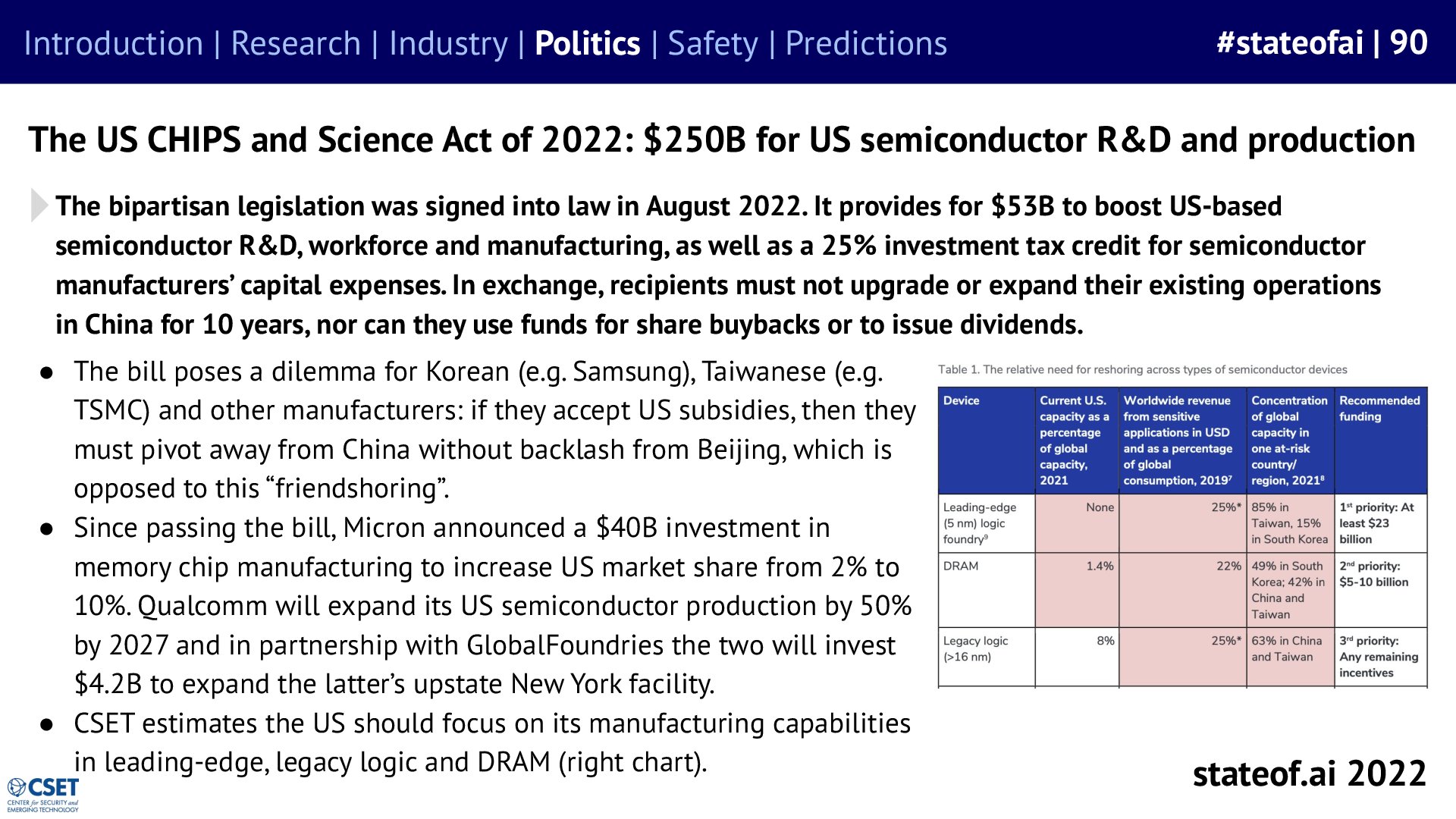
Financial support could change incentives to build factories, but it could not instantly deliver their output. The report’s construction-time comparison put a practical timescale on reshoring ambitions. Readers should separate legislation, investment announcements, construction, and production when judging progress toward greater semiconductor capacity.
Safety gains its own section and a larger research community
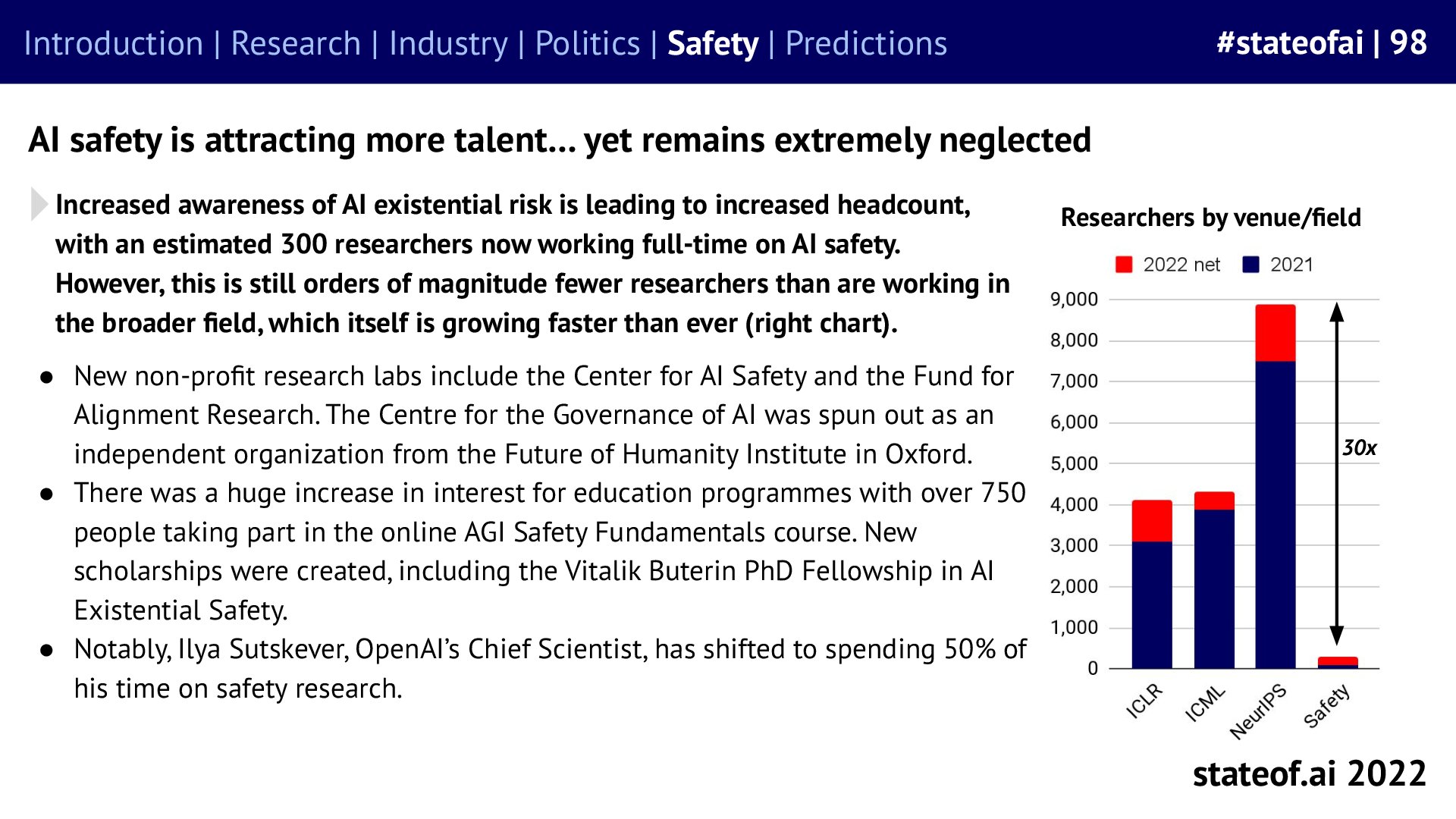
The 2022 report made safety a standalone section for the first time. It documented growing interest in the risks of highly capable systems and explained methods for improving language-model behavior. More research activity was a development to track, not evidence that the underlying problems were solved.
The report described an NYU approach that used human feedback written in natural language to improve a model directly. With 100 feedback samples, the researchers improved GPT-3 on a summarization task to the reported human level. The example raised a practical question alongside RLHF: how much information was being discarded when detailed human criticism was reduced to a preference or score?
The 2022 forecasts, in their original form
The forecasts anticipated further model and data scaling, generative audio, investment, and the governance of powerful AI labs. These are historical forecasts made at publication, not new predictions or retrospective claims of success.
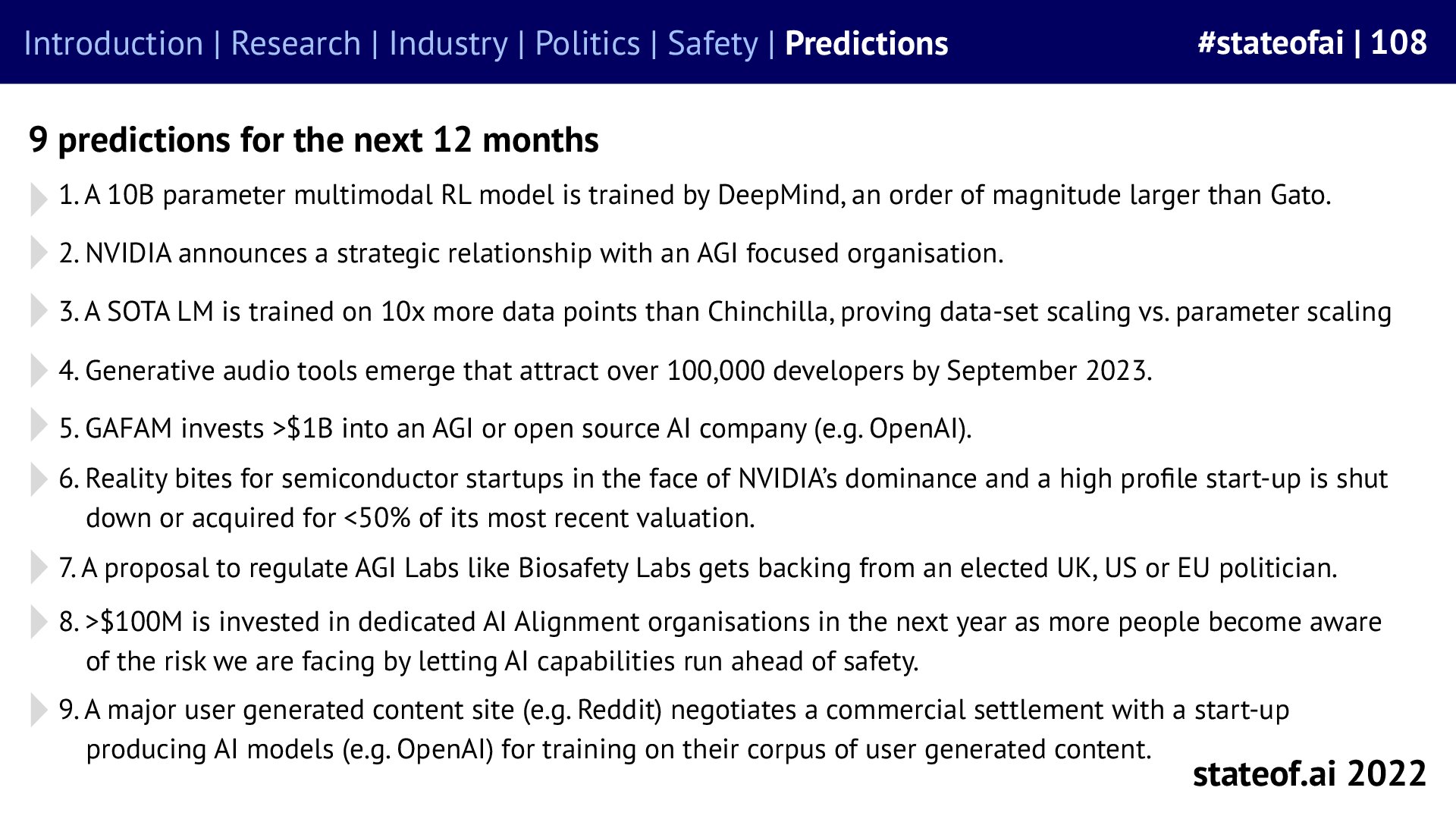
The list included training-data scale, developer uptake, financing, semiconductor valuations, and commercial access to user-generated content. These claims made the report’s view of the next year broader than model benchmarks alone. Each retained its own threshold, actor, and time condition for later assessment.
Three of the forecasts published in 2022:
- A SOTA LM is trained on 10x more data points than Chinchilla, proving data-set scaling vs. parameter scaling
- >$100M is invested in dedicated AI Alignment organisations in the next year as more people become aware of the risk we are facing by letting AI capabilities run ahead of safety.
- A major user generated content site (e.g. Reddit) negotiates a commercial settlement with a start-up producing AI models (e.g. OpenAI) for training on their corpus of user generated content.
The report is authored by Nathan Benaich and Ian Hogarth
For our writing throughout the year, subscribe to Air Street Press.
Cite the report
Benaich, N. and Hogarth, I. (2022). State of AI Report 2022. https://www.stateof.ai/2022